

I have always been curious about people. About what makes us who we are, the experiences we carry, the things we struggle to put into words, and the ways we find ourselves again when life feels overwhelming.
Looking back, my journey towards psychology began long before I knew what I wanted to do with my life. It began with the people I grew up around, the experiences that shaped how I saw the world, and a simple belief that has stayed with me: sometimes, being there for another person can make a difference in ways we may never fully realise.
Where It All Began
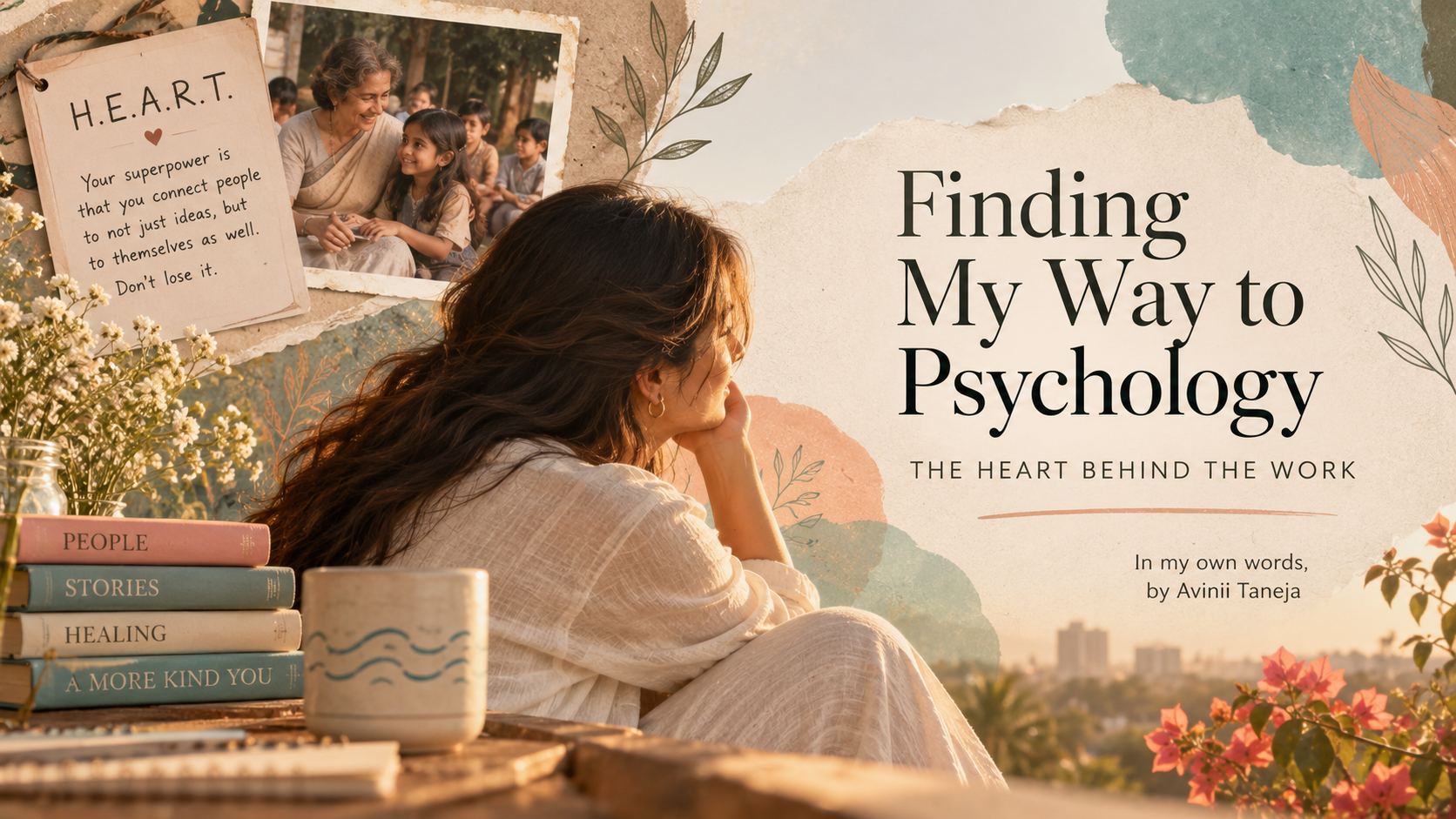
Some of my earliest lessons in caring for others came from watching my grandmother. She spent much of her life working with NGOs, and as a child, I would accompany her and spend time with people whose lives were very different from mine.
I didn't fully understand the significance of those experiences then. But watching her taught me that care doesn't always have to look like a grand gesture. Sometimes, it means giving someone your time, listening without judgement, or simply being present when they have few people to turn to.
As I grew older, I found myself naturally drawn to the same kind of connection.
When I was in the eleventh standard, at a summer camp in Rishikesh, my teachers gave me a title: H.E.A.R.T.
I still have the card they gave me.
They told me that my superpower was my ability to connect people, not just to ideas or to one another, but to themselves. At the time, I was simply someone who listened, often without realising how much that meant to the people around me. But someone had noticed something in me and reminded me not to lose it.
Those words have stayed with me ever since.
For a long time, I imagined becoming a doctor. I wanted to help people, but my fear of blood made me reconsider that path. Eventually, I found my way towards psychology, where my curiosity about people and my desire to make a difference found a place of their own.
Looking back, I can see the thread connecting the child who accompanied her grandmother to NGOs, the teenager who was called H.E.A.R.T., and the psychologist I am today.
Learning to Understand Myself, Too
My journey has also been shaped by my own experiences. Living with PCOD, navigating weight gain and struggling with self-image influenced the way I saw myself and understood confidence.
These experiences taught me that our relationship with ourselves can be complicated. We can know, intellectually, that our worth extends beyond our appearance and still struggle to believe it. We can offer kindness to everyone around us while finding it difficult to extend that same kindness inward.
This understanding has stayed with me throughout my journey. It reminds me that people are rarely defined by what they struggle with on the surface, and that understanding ourselves takes time, patience and compassion.
I began to see psychology as a way to explore these questions more deeply, not only about myself, but about the many different experiences that shape who we become.
Finding My Way to Psychology
I studied Theatre Studies, English and Psychology at Christ University. Theatre and literature taught me to look beyond what is immediately visible, while psychology gave me a framework to understand human experiences more deeply.
My formal journey in psychology began in 2018. I went on to complete a Master's in Criminology at the University of Manchester, exploring how environment, trauma and circumstance shape behaviour, followed by a Master's in Psychology at IGNOU.
Since beginning my professional practice in 2023, I have worked across counselling, crisis intervention and employee mental health, including experiences with Anamkaaruh, Friends Square, Nova IVF Fertility, Ganaa and Mind Vriksha.
Each experience has reinforced something I believe deeply: people don't always need someone to tell them what to do. Sometimes, they need the space to understand what they are feeling, make sense of their experiences and discover their own way forward.
How I Work
My approach is trauma-informed, collaborative and grounded in evidence-based practice. I draw on approaches such as Cognitive Behavioural Therapy (CBT), Dialectical Behaviour Therapy (DBT) and Solution-Focused Brief Therapy, adapting my work to each individual.
Beyond the techniques I use, I want therapy to feel like a space where you can be honest. A space where you don't have to explain your feelings perfectly, minimise your experiences or arrive with all the answers.
I don't believe people need to be fixed to become worthy of care. I believe they deserve the opportunity to understand themselves, develop healthier ways of coping and build a relationship with themselves that feels more compassionate.
For me, therapy is not about becoming someone else. It is about understanding who you are, what you have been carrying, and what you might want your life to look like from here.
Why Marea Wellness?
Marea Wellness began as a mother-daughter journey between my mother, Pooja, and me. We approach wellbeing from different perspectives, but we share the belief that meaningful change looks different for everyone.
Building Marea together means creating a space where people can find support that meets them where they are, without being told that their journey should look a certain way.
The name Marea, meaning tide, felt fitting to us. Like the tides, we move through periods of uncertainty, change, stillness and renewal. Sometimes we move forward; sometimes we need to pause and understand where we are.
We wanted Marea to make room for all of that.
For me, this work has never been about changing the world all at once. If I can make a meaningful difference in even one person's life, helping them feel a little more understood, a little less alone, or a little more able to face something that once felt overwhelming, I feel that my work has mattered.
Perhaps that is what my teachers were trying to tell me all those years ago in Rishikesh. My superpower was connection. Not having all the answers, but helping someone reconnect with themselves.
It is a quality I continue to value, a responsibility I take seriously, and a part of myself I hope I never lose.
If You Have Found Your Way Here
You don't need to arrive at therapy knowing exactly what is wrong or what you want to change. You can arrive with questions, uncertainty, or simply a feeling that something needs attention.
We can start there.
I am still learning, both as a psychologist and as a person. I hope I always remain curious enough to listen, humble enough to question what I think I know, and present enough to recognise the person behind the experiences they share with me.
You don't have to have all the answers to begin. Sometimes, it starts with having the space to be heard.
If you are thinking about starting therapy, I would be glad to meet you where you are.
With care,
Avinii Taneja